
I'm starting a petition...
Bulletins from a French butcher's shop

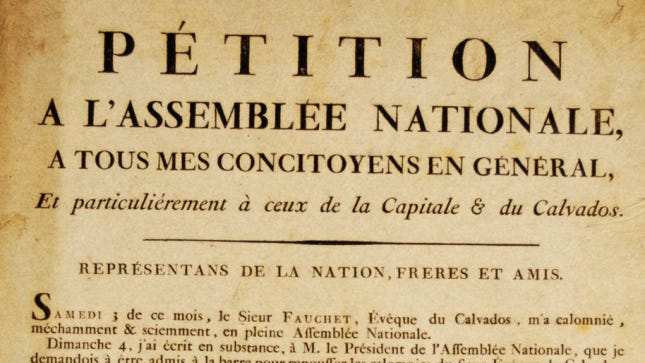
France should take a long look at Donald Trump and reach the obvious conclusion, according to Monsieur Josito Bargas, who is campaigning for an upper age limit for future French presidents.
“We need to avoid a gerontocracy,” Bargas declares. In the hope of attracting enough support to change current French law (which specifies no such age limit), he has resorted to one of the great treasures of the French political system.
He has signed onto the website of the French parliament – L’Assemblée Nationale – and launched an official petition entitled “Limit the age of the French president to 60 years”. All he needs now is 100,000 signatures to be taken seriously, and 500,000 to force a parliamentary debate. After two months online, his petition has so far rallied 22 supporters.
In an age when pundits, podcasters and assorted influencers routinely attract millions of followers with the nuttiest ideas, it’s easy to mock an official government website for zealots, crackpots, nutjobs and weirdos who try to make a case for daily disinfection of aeroplanes; for the criminalisation of fat-shaming; and for new laws governing the custody of cats after divorce. All these subjects appear on the Assemblée’s list of current petitions.
Yet the French government has long taken the view that the voice of the people must be heard in high places, however bonkers those people sound. Democracy cannot be left to X and TikTok. And I discovered this week that some people take their petitions very seriously indeed. Some of them are not bonkers at all.
Most petitions, of course, fail to reach 100 signatures, let alone 100,000. Karine Grech, who is something of a serial petitioner, has attracted only two supporters for her brave yet hopeless quest for airline passengers arriving in France to be checked for “undesirable insects hidden in their clothing”. She wants all planes operated by low-cost airlines to be disinfected every time they land, on health and safety grounds. We don’t want any English fleas over here, thanks.
Stéphanie Gomes, on the other hand, wants action to be taken against French businesses that close down in August and require their employees to use up three weeks of their holiday allowance while the factories are closed. August, Ms Gomes points out, is the most expensive month for hotels and related summer attractions in France. Why should the country’s poorest-paid workers be doomed to its most expensive holidays? Why can’t they hit the cheapo beaches in June? Ten signatures for Ms Gomes so far.
It’s a different story for weightier issues that have divided the country. France has often been criticised by the European Court of Human Rights over accusations of excessive brutality by police and security forces. France is the EU country with the highest numbers of its own citizens killed or wounded by police action.
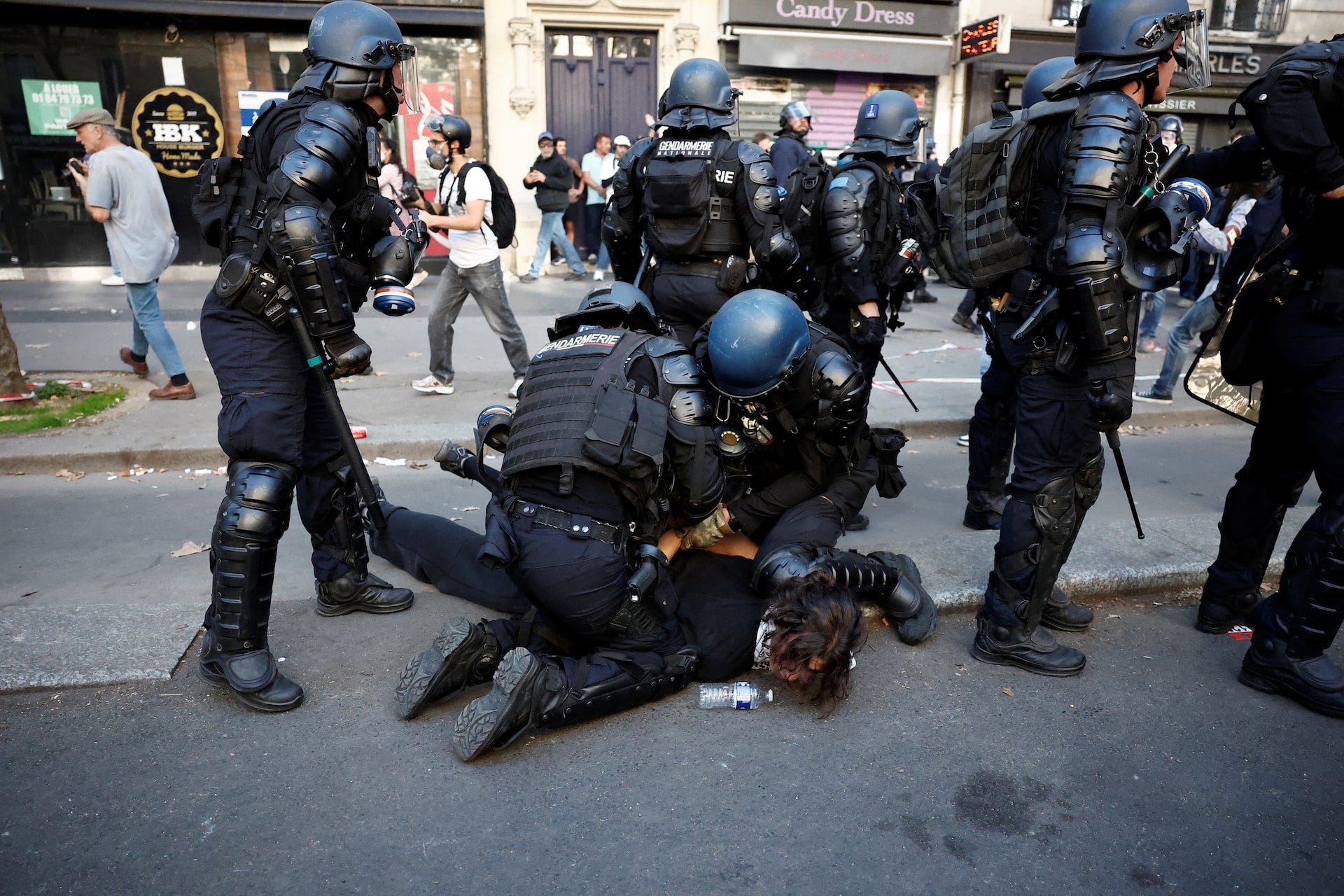
Photo: Reuters /Benoit Tessler
An intended attempt to shield the forces of law and order from prosecution over the use of violence has incited furious opposition. By introducing a legal presumption of self-defence for officers on duty, the government is effectively transferring the burden of proof in cases of death or injury from police to victims, argued Isam el Khalfaoui. It would no longer be up to the police to show they were justified in beating you; it would be up to you (or your grieving heirs) to prove that you were wrongly beaten. Isam’s petition to block the change attracted 567,141 signatures, qualifying it for a formal debate (but not guaranteeing a favourable outcome).
I first learned of this admirable outlet for modern French expressionism as a result of another petition, supported by many of the environmental activist residents of our village. Farmers complaining of low produce prices and increasing restrictions on their livelihoods have long been campaigning for the right to use bee-killing pesticides banned in France years ago. The farmers argue that their crops are plagued by insects and their yields suffer as a result. Yet most of my neighbours - and many others in France - have no desire whatsoever to see local fields sprayed with poison.

When a pro-farming parliamentary senator, Laurent Duplomb, proposed re-legalising bee-killing pesticides in an amendment to a farm aid bill earlier this year, the Green movement roared into action. A petition by Eleonore Pattey, a 23-year-old student, rallied 2,131,368 signatures. A subsequent petition by a supporter of the farmers demanded that Ms Pattey’s petition be ignored (111 signatures so far). I have somehow refrained myself from starting a third petition demanding that the second petition be banned from belittling the first petition.
All this might justly be hailed as an admirable sign of orderly democracy in action, for all France’s sometimes virulent differences over Emmanuel Macron, Marine Le Pen and their diverse cohorts of modern political deplorables.
The reality, of course, is that the French government is still far from going the Swiss route of deciding its policies by national referendum. Numerous pundits have pointed out that there is no guaranteed petition path to victory, however many signatures you accumulate. The government is under an obligation to listen, but under no legal compulsion to act.
The outcome of the pesticide issue will ultimately boil down to a political calculation weighing support for farmers against the influence of the Greens. A French lawmaker might easily ignore two million likes on a social media post, but two million authenticated French signatures on an official website will be harder to dismiss.
Whatever the pesticide outcome it seems unlikely the French government will be obliging Monsieur Bargas and banning 60-year-old presidents any time soon. It’s perhaps worth remembering that both Charles de Gaulle and Francois Mitterrand remained president until they were 78. Neither inspired a notable urge to bar older presidents. Emmanuel Macron, by contrast, remains practically in short trousers. He will leave office aged 49, his youthfulness having proved no obvious advantage.

Illustration: “I’ll bring you luck” - Chaunu /L’Union
So Bargas is likely to be disappointed, but not Marine Le Pen – the Joan of Arc of right-wing France - who was recently cleared to run for president next year despite her conviction for embezzling funds from the European Parliament.
If she finally drags her unseemly gang of right-wing rabble-rousers to victory, Le Pen would take office next May aged nearly 59. If Bargas got his way she would be facing enforced retirement within little more than a year.
But first we’ll have to wait and see if Marine can somehow turn Europe on its head by pulling off a crook-to-kingpin stunt, à la fellow felon Donald Trump. What we really need here is a petition demanding wiser electorates.
Sadly your neighbours and mine will be voting for her. Trump, Le Pen … criminality is no bar to electoral success in the present political climate. I’ve dual nationality and will register my protest vote in vain