
When is enough enough?
Bulletins from a French butcher's shop

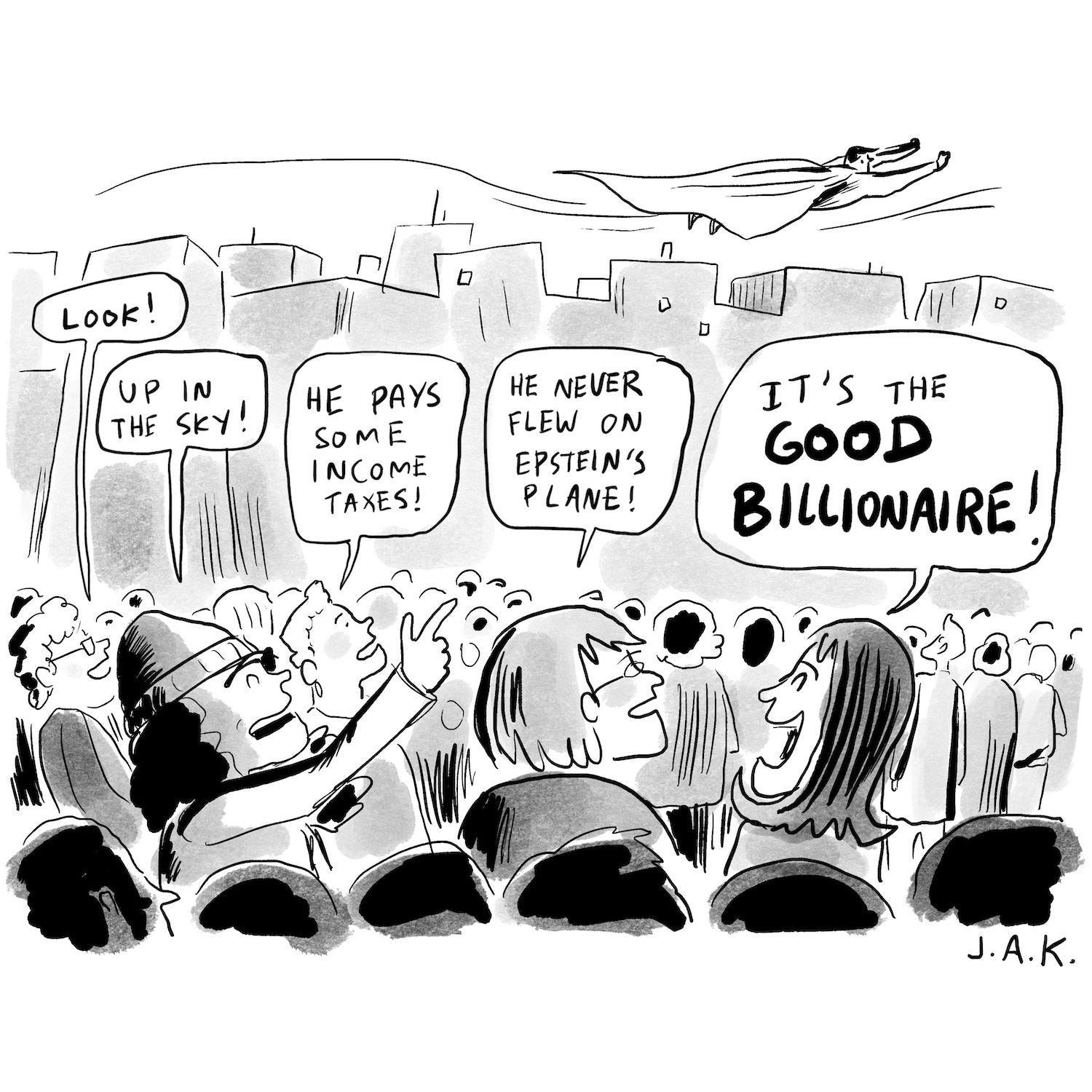
Cartoon: The New Yorker
I once had occasion to write about Britain’s House of Lords, a parliamentary body I referred to as “one of the country’s most eccentric institutions…. often home to a sparkling array of crackpots and rogues”.
I retold the tale of the 3rd Earl Moynihan, whose obituary described him as a “bongo-drummer, confidence trickster, brothel-keeper, drug-smuggler and police informer”. Moynihan married a Malaysian belly-dancer who later ran a string of massage parlours. Many British aristocrats display family coats of arms with Latin mottos dating back centuries. The motto Moynihan engraved on a plaque in his Manila office read: “Of the 36 ways of avoiding disaster, running away is the best”.
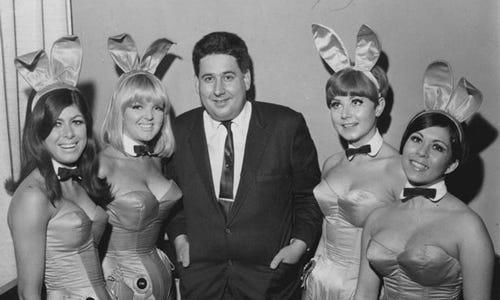
Photo: Earl Moynihan and friends
Then there was Gerald Hugh Tyrwhitt-Wilson, the 14th Baron Berners and an aesthete of uncommon taste. As a child he was told that if you threw a dog in a swimming pool, it would instantly learn how to swim. So he threw his mother’s dog out of a window, to see if it would learn how to fly (the dog survived; Berners had his bottom smacked).
As a grown-up, Lord Berners’s idea of fun was to dye the feathers of the birds in his pigeon loft in extravagant hues of pink and purple to amuse the guests who attended his parties. He installed a clavichord keyboard in his Rolls-Royce and once invited a horse to tea.
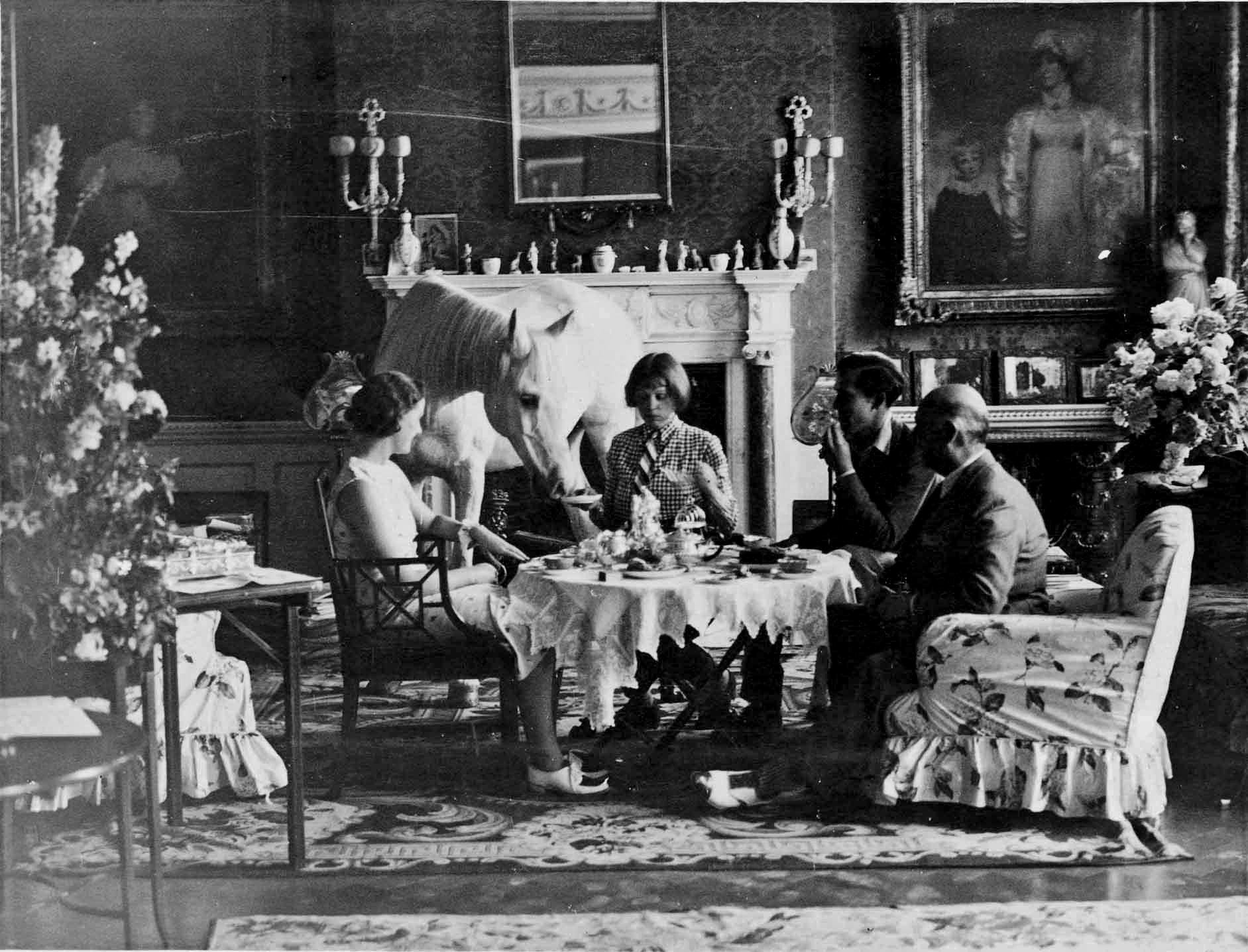
Photo: Tea-time for Trigger
Much later, the celebrated Irish talk show host Terry Wogan once interviewed Brinsley le Poer Trench, aka both the 8th Earl of Clancarty and, via a different family line, the 7th Marquess of Heusden. Clancarty had established himself as Britain’s leading expert on UFOs, and once succeeded in arranging a Lords debate on the government’s alleged cover-up of visits by aliens from outer space.
In his chat with Wogan, Clancarty’s conspiracy theories proved so wildly extraterrestrial that the interviewer was left grasping for a response (the Earl believed, among other lunacies, that the planet Earth was hollow, and that alien civilisations had established colonies beneath its crust). Eventually Wogan politely inquired: “What would you say to people who say…. (long pause while Wogan searched for the right word) …. you’re bonkers?”
I mention all this because I’ve been thinking of late of a more recent member of the House of Lords, a respected businessman who had somehow come to be ranked somewhere between the comics and the criminals on the House of Lords roster of eccentrics.
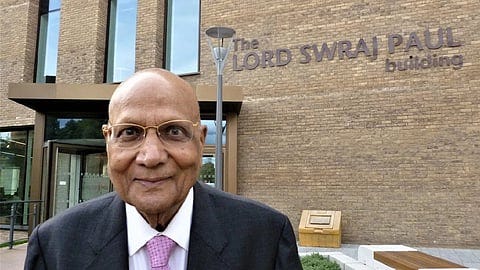
I came to know him well, largely because he invited me to write his biography. Swraj Paul, Baron Paul of Marylebone, died last year aged 94. Born in India but transplanted to London after a family tragedy, he became a billionaire steel magnate whose political activism and financial support of the Labour Party eventually earned him a life peerage.
Yet no sooner had this son of a humble Punjabi bucket-maker begun to rub shoulders with the Lords and Ladies of Westminster than he became embroiled in a bizarrely damaging scandal. The billionaire was caught fiddling his expenses. I’ve thought of Swraj’s scandal often in this modern age of ultra-rich excess, this age of billionaire presidents, trillionaire corporations and their outsized impact on all our lives.

Photo: Swraj Paul
As Swraj’s wholly unexpected (and not very wise) choice as his intended biographer, it fell to me to try and make sense of his starring role in what became known as the House of Lords expenses scandal. Underlying it all was a strangely disturbing question, as relevant today, it seems to me, as it was on Sunday 11th October 2009, when The Sunday Times – my own paper – splashed the excruciating findings of an investigation into Lord Paul’s expense claims.
Why on earth would a billionaire spend two years submitting bogus parliamentary travel claims to a house he claimed to live in at the time but didn’t? Why did Swraj pretend to be living outside London when he housed his entire family in a block of flats he owned in Portland Place, opposite the BBC’s Broadcasting House and 15 minutes by tube from Westminster? He clearly didn’t need the travel and other allowances he claimed - around £30,000 in all, in sums as small as £65 a day. But billionaires can be funny about money. We can learn from them in ways they would rather we didn’t.
The finer details of this silly and demeaning affair no longer really matter. Suffice it to say that my own investigation could find no reason to exonerate Swraj of monumental stupidity in submitting claims for travel expenses that were dodgy at best and fraudulent at worst. (My conclusions on this subject, incidentally, were among several reasons my biography project collapsed. The book was never published and Swraj never spoke to me again).
I was left with a question that keeps on bothering me. Why, for some men (and they are usually but not always men) is enough never enough? Can you imagine who I might be referring to when I write that almost every day the world’s most bilious billionaire, seemingly not content with the unmatched power and prestige of his position, pulls out of his pocket some ratbag scheme to fleece the public purse for a few more hundred thousands or millions? The crypto tokens. The ‘gold’ phone. The vanity bibles. The $1.8 billion dollar slush fund for his buddies. The settlements with menace of billion dollar lawsuits (he refiled his $10 billion dollar defamation claim against the Wall Street Journal this week).
But this, for once, isn’t all about Trump. Long before he turned to politics as piggy bank I struggled to understand why the stratospherically rich got so offended when anyone suggested they pay more tax. (Not all of them, of course. There are plenty of genuine philanthropists around who put their money where others need it; some of them shun inherited wealth and set about giving it all away).
But we’ve all been told how wrong it would be to tax the rich. We are all better off, it is repeatedly claimed, if billionaires avoid subsidising governments riddled with corruption and inefficiency. Freed of punitive tax grabs, the rich can use their skills and fortunes to create more wealth to invest wisely and generate economic benefits for us all. Do let me know if that’s working for you. Perhaps you might wonder why so many billionaires subsidise corrupt and inefficient politicians in ways that they prefer not to declare.

Cartoon: The New Yorker
But somewhere in all this there remains the question: what drives billionaires to keep adding to their billions? Why does anyone need more than $1 billion? When is enough enough?
In my search for an explanation of Swraj’s penny-pinching, I talked to members of his family, his staff and several wealth managers. I also talked to Baroness Eliza Manningham-Buller, the former head of MI5 who, soon after she retired, was elevated to the House of Lords and became the chairman of the sub-committee charged with investigating Swraj’s conduct.
Swraj, then 79 years old, was duly summoned to a formal hearing at which he was grilled ruthlessly over his unswerving claim that he was entitled to designate a country home he was not living in as his principal residence, thereby enabling him to claim a daily travel allowance for travel he was not undertaking to and from Westminster. Over several hours of testimony, Lady Eliza’s five-member panel lobbed 177 versions of the question “where do you really live?” without ever cracking Swraj’s stubborn defiance.
The final paragraph of the sub-committee’s report gave him short shrift: “Not only did he make false claims, but he presented the sub-committee with an understanding of the scheme which no reasonable person could hold, in an attempt to disguise the deliberate nature of his deception”.
In short, the sub-committee concluded, the billionaire really had fiddled his expenses. Swraj’s otherwise remarkable life would forever be stained by his inky, hand-written expense claims.
There were subsequent attempts to introduce hints of racism in the treatment of Indian-born Lords (Swraj was not the only Asian peer accused of fiddling). It was also clear that Swraj had fallen victim to the oldest trick in the book. He told me, entirely believably, that he had been assured by many of his fellow Lords “don’t worry - everybody’s doing the same thing. It’s no more than we deserve for turning up”. But there was no escaping the verdict of his peers.
I came to like Swraj a great deal - a bad mistake for a biographer. But he remained to the end funny about money. He hated the word ‘rich’ and repeatedly described himself as ‘lucky’. He gave away a small fortune to the diverse causes he supported - London Zoo, the University of Wolverhampton, his former hometown in India. But his gifts often required extensive negotiation. He wanted the Paul name to be attached to most of the projects he supported: a university library or study block; an animal enclosure at London Zoo; various buildings in his former hometown in India. He named buildings for his wife, for his beloved lost daughter Ambika and for his youngest son and chosen heir Angad, who committed suicide by jumping from the terrace of his London penthouse in November 2015. The Sunday Times asked me to investigate and that was how I came to spend the next two years talking to Swraj.
In short, he was a complicated billionaire. I eventually persuaded Baroness Manningham-Buller to give me a quote on the record about his House of Lords shenanigans. Today, whenever I hear a billionaire talking about money, or tax, or “trickle down” wealth, I think of the words of the former director-general of MI5:
“All I will say is that a friend of mine, now retired, became a senior partner of an accountancy firm. He started off at the bottom auditing expense forms and told me that often the best paid fiddled the most”.
Intriguing stuff, Tony...clearly our childhoods were not sufficiently troubled...